
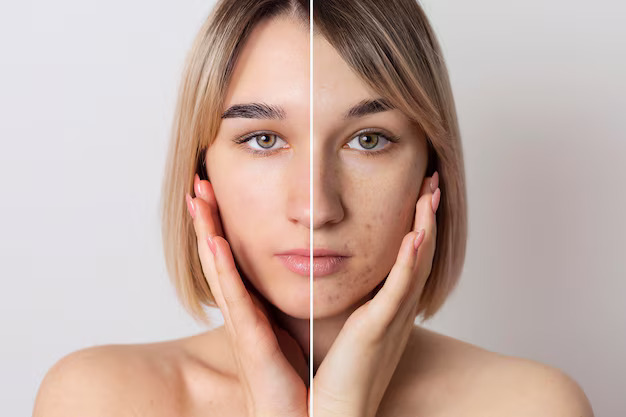
What Is Hyperpigmentation?
Hyperpigmentation is a common skin condition where certain areas of the skin become darker than the surrounding skin. This happens due to an overproduction of melanin, the pigment responsible for skin color.
It can appear as :
Dark spots
Uneven skin tone
Post-acne marks
Sun spots
While hyperpigmentation is not harmful, it can be persistent and difficult to treat without the right approach.
The Science of Melanin (Why Dark Spots Form)
Melanin is produced by specialized cells called melanocytes. These cells respond to various triggers and produce pigment as a protective mechanism.
Melanin production increases when the skin is exposed to:
UV radiation
Inflammation
Hormonal changes
This process is controlled by an enzyme called tyrosinase. When tyrosinase activity increases, melanin production also increases, leading to visible dark spots.
What Causes Hyperpigmentation?
Hyperpigmentation is not caused by a single factor. It develops due to multiple internal and external triggers.
1. Sun Exposure (Primary Cause)
UV radiation is the most common trigger of hyperpigmentation.
When skin is exposed to sunlight:
Melanin production increases
Existing dark spots become darker
New spots may form
Without daily protection, treating pigmentation becomes almost impossible.
Using Maruderm SPF 50+ Vitamin C Sunscreen helps protect the skin from UV damage and prevents further discoloration.
2. Inflammation (Post-Inflammatory Hyperpigmentation)
Inflammation from acne, irritation, or skin injury can trigger melanin production.
This leads to:
Dark marks after acne
Uneven skin tone
Persistent discoloration
This type of pigmentation is called post-inflammatory hyperpigmentation (PIH).
3. Hormonal Changes
Hormonal fluctuations can trigger pigmentation, especially in conditions like melasma.
Triggers include:
Pregnancy
Hormonal imbalances
Birth control
This type of pigmentation is often deeper and more resistant to treatment.
4. Skin Barrier Damage
A weakened skin barrier makes the skin more sensitive to external triggers.
When the barrier is compromised:
Inflammation increases
Skin becomes reactive
Pigmentation worsens
Maintaining hydration with Maruderm Hyaluronic Acid Moisturizing Cream helps support the barrier and reduce sensitivity.
Post-Acne Marks vs Scars: What’s the Difference?
Many people confuse post-acne marks with acne scars, but they are not the same.
Post-Acne Marks (Hyperpigmentation)
Flat discoloration
Brown, red, or purple in color
Caused by excess melanin
Temporary and treatable
Acne Scars
Permanent changes in skin texture
Depressed or raised areas
Caused by collagen damage
Understanding this difference is important because treatment methods are completely different.
Why Dark Spots Take So Long to Fade
Hyperpigmentation is slow to treat because melanin is stored deep within the skin.
Factors affecting treatment speed:
Depth of pigmentation
Skin type
Sun exposure
Consistency of routine
Without proper care, dark spots can persist for months or even years.
The Importance of a Structured Routine
Removing dark spots requires consistency and balance.
A proper routine should:
Protect the skin from UV damage
Reduce melanin production
Support skin renewal
Maintain hydration
Using a gentle cleanser like Maruderm Salicylic Acid Face Cleansing Gel helps remove impurities and prepares the skin for treatment.
Common Mistakes in Treating Hyperpigmentation
Skipping sunscreen
Using too many active ingredients
Over-exfoliating
Expecting quick results
Inconsistent routine
These mistakes often worsen pigmentation instead of improving it.
How Hyperpigmentation Progresses Over Time
If left untreated:
Spots become darker
Skin tone becomes uneven
Pigmentation becomes more resistant
Early and consistent treatment is key to preventing long-term discoloration.
FAQ
1. What is the main cause of dark spots?
Excess melanin production triggered by sun exposure or inflammation.
2. Are dark spots permanent?
No, but they can take time to fade.
3. Does the sun worsen pigmentation?
Yes, UV exposure increases melanin production.
4. What is melanin?
A pigment that gives skin its color.
5. Can acne cause dark spots?
Yes, through post-inflammatory hyperpigmentation.
6. Are scars the same as dark spots?
No, scars affect texture, spots affect color.
7. Why does pigmentation return?
Due to sun exposure and inflammation.
8. Can sensitive skin get hyperpigmentation?
Yes, especially if the barrier is damaged.
9. How long does it take to fade dark spots?
Several weeks to months.
10. Is sunscreen necessary?
Yes, it is essential.
Niacinamide vs Vitamin C: Which Is Better for Skin Brightening?
When it comes to treating hyperpigmentation and achieving a more even skin tone, two ingredients consistently stand out: niacinamide and vitamin C. Both are widely used in dermatology and dermocosmetic formulations, but they work through different biological pathways.
Understanding how they function allows you to use them more effectively instead of relying on trial and error.
How Niacinamide Works
Niacinamide, also known as vitamin B3, is a multi-functional ingredient that improves overall skin health while targeting pigmentation.
It works by:
Reducing the transfer of melanin to skin cells
Regulating sebum production
Strengthening the skin barrier
Reducing inflammation
Niacinamide does not directly stop melanin production but instead prevents it from spreading unevenly across the skin. This results in a more balanced and uniform complexion over time.
It is especially suitable for:
Sensitive skin
Acne-prone skin
Redness and irritation
How Vitamin C Works
Vitamin C is a powerful antioxidant that directly targets pigmentation at its source.
It works by:
Inhibiting the tyrosinase enzyme
Reducing melanin production
Neutralizing free radicals caused by UV exposure
Supporting collagen synthesis
Unlike niacinamide, vitamin C actively slows down the creation of pigment, making it highly effective for brightening dull and uneven skin.
However, it can be more sensitive to formulation and stability, which is why consistent use and proper storage are important.
Niacinamide vs Vitamin C: Key Differences
Niacinamide:
Focuses on balancing and strengthening the skin
Reduces inflammation and redness
Helps regulate oil production
Vitamin C:
Targets pigmentation more directly
Protects against environmental damage
Brightens the overall complexion
Which One Should You Choose?
The most effective approach is not choosing one over the other, but using them strategically.
Use vitamin C in the morning for antioxidant protection
Use niacinamide to support barrier function and balance oil production
When combined with daily protection using Maruderm SPF 50+ Vitamin C Sunscreen, this creates a strong defense against pigmentation triggers.
Best Ingredients for Skin Brightening That Actually Work
Not all brightening ingredients deliver real results. The most effective ones target melanin production, inflammation, and skin renewal.
1. Azelaic Acid
Azelaic acid is one of the most versatile ingredients for treating hyperpigmentation.
It:
Inhibits tyrosinase
Reduces inflammation
Helps with post-acne marks
It is especially useful for individuals with both acne and pigmentation.
2. Niacinamide
Niacinamide improves overall skin tone by reducing uneven pigment distribution and strengthening the skin barrier.
It is well-tolerated and suitable for daily use.
3. Vitamin C
Vitamin C remains one of the most effective ingredients for brightening and protecting the skin.
It:
Reduces oxidative stress
Improves skin radiance
Supports collagen production
4. Exfoliating Acids (AHA/BHA)
Chemical exfoliants help remove pigmented dead skin cells from the surface.
They:
Accelerate cell turnover
Improve skin texture
Enhance absorption of other ingredients
A cleanser like Maruderm Salicylic Acid Face Cleansing Gel helps maintain pore clarity and supports gentle exfoliation as part of a routine.
5. Hydrating Ingredients
Hydration plays a critical role in skin renewal.
Dehydrated skin:
Heals more slowly
Becomes more reactive
Is more prone to pigmentation
Using Maruderm Hyaluronic Acid Moisturizing Cream helps maintain moisture balance and supports skin recovery.
How to Build a Skin Brightening Routine
A proper routine should focus on protection, correction, and maintenance.
Morning Routine
Step 1: Cleanse
Step 2: Apply vitamin C or niacinamide
Step 3: Moisturize
Step 4: Apply sunscreen
Using Maruderm SPF 50+ Vitamin C Sunscreen is essential to prevent UV-induced pigmentation.
Evening Routine
Step 1: Cleanse
Step 2: Apply targeted treatment (azelaic acid, niacinamide)
Step 3: Moisturize
Why Consistency Matters More Than Strength
One of the biggest misconceptions is that stronger products work faster.
In reality:
Overuse of actives causes irritation
Irritation triggers inflammation
Inflammation leads to more pigmentation
Consistent use of balanced products delivers better long-term results.
Common Mistakes When Treating Dark Spots
Skipping sunscreen
Using too many active ingredients
Over-exfoliating the skin
Switching products too frequently
Expecting immediate results
Avoiding these mistakes is critical for achieving visible improvement.
How Long Does It Take to See Results?
Hyperpigmentation treatment requires patience.
Typical timeline:
Weeks 2–4: Skin begins to stabilize
Weeks 4–8: Tone becomes more even
Weeks 8–12: Dark spots visibly fade
Consistency is the most important factor.
FAQ
1. Is niacinamide or vitamin C better for dark spots?
Both are effective and work best when used together.
2. Can I use niacinamide and vitamin C together?
Yes, they complement each other.
3. Does vitamin C remove dark spots completely?
It helps fade them but requires consistent use.
4. Is niacinamide safe for sensitive skin?
Yes, it is well-tolerated.
5. Can exfoliation help pigmentation?
Yes, but it should be done gently.
6. How often should I exfoliate?
Depends on skin type, usually 2–3 times per week.
7. Does hydration affect pigmentation?
Yes, hydrated skin heals faster.
8. Can I skip sunscreen indoors?
It is still recommended daily.
9. Why are my dark spots not fading?
Likely due to inconsistent routine or sun exposure.
10. Can pigmentation get worse before improving?
Yes, if the skin is irritated.
Why Dark Spots Keep Coming Back
One of the most frustrating aspects of hyperpigmentation is recurrence. Many people successfully fade dark spots, only to see them return after a short period of time.
This happens because the underlying triggers of melanin production are still active.
Hyperpigmentation is not just about removing existing pigment. It is about controlling the processes that continuously stimulate melanin production.
1. Sun Exposure (The #1 Reason for Recurrence)
UV radiation is the most powerful trigger for melanin production.
Even minimal exposure can:
Reactivate melanocytes
Darken existing spots
Create new pigmentation
Without daily protection, even the most effective treatments will fail.
Consistent use of Maruderm SPF 50+ Vitamin C Sunscreen helps block UV-induced pigmentation and protects results long-term.
2. Ongoing Inflammation
Any form of skin irritation can trigger pigmentation.
Common sources include:
Acne
Over-exfoliation
Harsh skincare products
Environmental stressors
Inflammation activates melanocytes, leading to post-inflammatory hyperpigmentation.
3. Weak Skin Barrier
A compromised skin barrier makes the skin more reactive and prone to discoloration.
When the barrier is damaged:
Skin becomes sensitive
Healing slows down
Pigmentation becomes more persistent
Maintaining hydration with Maruderm Hyaluronic Acid Moisturizing Cream supports barrier repair and reduces sensitivity.
4. Inconsistent Skincare Routine
Hyperpigmentation treatment requires consistency.
Frequent product changes:
Disrupt skin balance
Delay results
Increase irritation
A stable routine is essential for long-term improvement.
How to Prevent Dark Spots from Returning
Preventing hyperpigmentation is just as important as treating it.
1. Daily Sun Protection
Sunscreen is non-negotiable.
Using Maruderm SPF 50+ Vitamin C Sunscreen daily:
Prevents UV damage
Reduces melanin activation
Protects against recurrence
2. Control Inflammation
Reducing irritation helps prevent new pigmentation.
This includes:
Avoiding harsh treatments
Using calming ingredients
Maintaining a balanced routine
3. Support Skin Renewal
Healthy cell turnover helps fade existing pigmentation and prevent buildup.
Gentle exfoliation and consistent cleansing support this process.
Using Maruderm Salicylic Acid Face Cleansing Gel helps keep pores clear and supports skin renewal without disrupting balance.
4. Maintain Hydration
Hydrated skin heals faster and is less prone to inflammation.
Using Maruderm Hyaluronic Acid Moisturizing Cream helps maintain moisture balance and supports skin resilience.
Complete Hyperpigmentation Routine (Long-Term Strategy)
Step 1: Cleanse
Use Maruderm Salicylic Acid Face Cleansing Gel
to remove impurities and prepare the skin.
Step 2: Treat
Apply targeted ingredients such as:
Azelaic acid
Niacinamide
Vitamin C
These ingredients help regulate melanin production and improve skin tone.
Step 3: Moisturize
Use Maruderm Hyaluronic Acid Moisturizing Cream
to support hydration and barrier function.
Step 4: Protect
Apply Maruderm SPF 50+ Vitamin C Sunscreen daily to prevent recurrence.
Why Simple Routines Deliver Better Results
Many people believe that complex routines with multiple products provide better results. In reality, overly complicated routines often lead to irritation and inconsistency.
A simple routine:
Is easier to maintain
Reduces risk of irritation
Provides more stable results
Consistency is more important than complexity.
How Long-Term Skin Behavior Changes
With a proper routine:
Melanin production becomes more controlled
Skin tone becomes more even
Dark spots fade gradually
New pigmentation is less likely to form
These changes occur over time and require patience.
The Role of Lifestyle in Hyperpigmentation
Sun Exposure Habits
Even with sunscreen, prolonged sun exposure can worsen pigmentation. Limiting direct exposure improves results.
Stress and Skin Health
Stress increases inflammation, which can trigger pigmentation.
Managing stress supports overall skin balance.
Diet and Skin Function
A balanced diet supports skin repair and reduces oxidative stress, contributing to healthier skin.
The Biggest Mistakes That Worsen Dark Spots
Skipping sunscreen
Over-exfoliating
Using too many active ingredients
Ignoring hydration
Expecting fast results
Avoiding these mistakes significantly improves treatment outcomes.
Final Perspective: Treating Hyperpigmentation the Right Way
Hyperpigmentation is not just a cosmetic concern. It is a biological response that requires a strategic and consistent approach.
The most effective treatment focuses on:
Reducing melanin production
Controlling inflammation
Protecting the skin
Maintaining hydration
With the right routine and consistency, it is possible to achieve a clearer, more even skin tone.
FAQ
1. Why do dark spots come back?
Due to ongoing triggers like sun exposure and inflammation.
2. Is sunscreen necessary every day?
Yes, even indoors.
3. Can hyperpigmentation be prevented?
Yes, with proper skincare and protection.
4. Does hydration help reduce pigmentation?
Yes, it supports skin healing.
5. Can stress cause dark spots?
Indirectly, through inflammation.
6. Is exfoliation necessary?
Yes, but it should be gentle.
7. Can I stop treatment after spots fade?
Maintenance is still required.
8. How long should I use brightening products?
Consistently for several months.
9. What is the fastest way to remove dark spots?
There is no instant method—consistency is key.
10. What is the most important step?
Daily sun protection.