
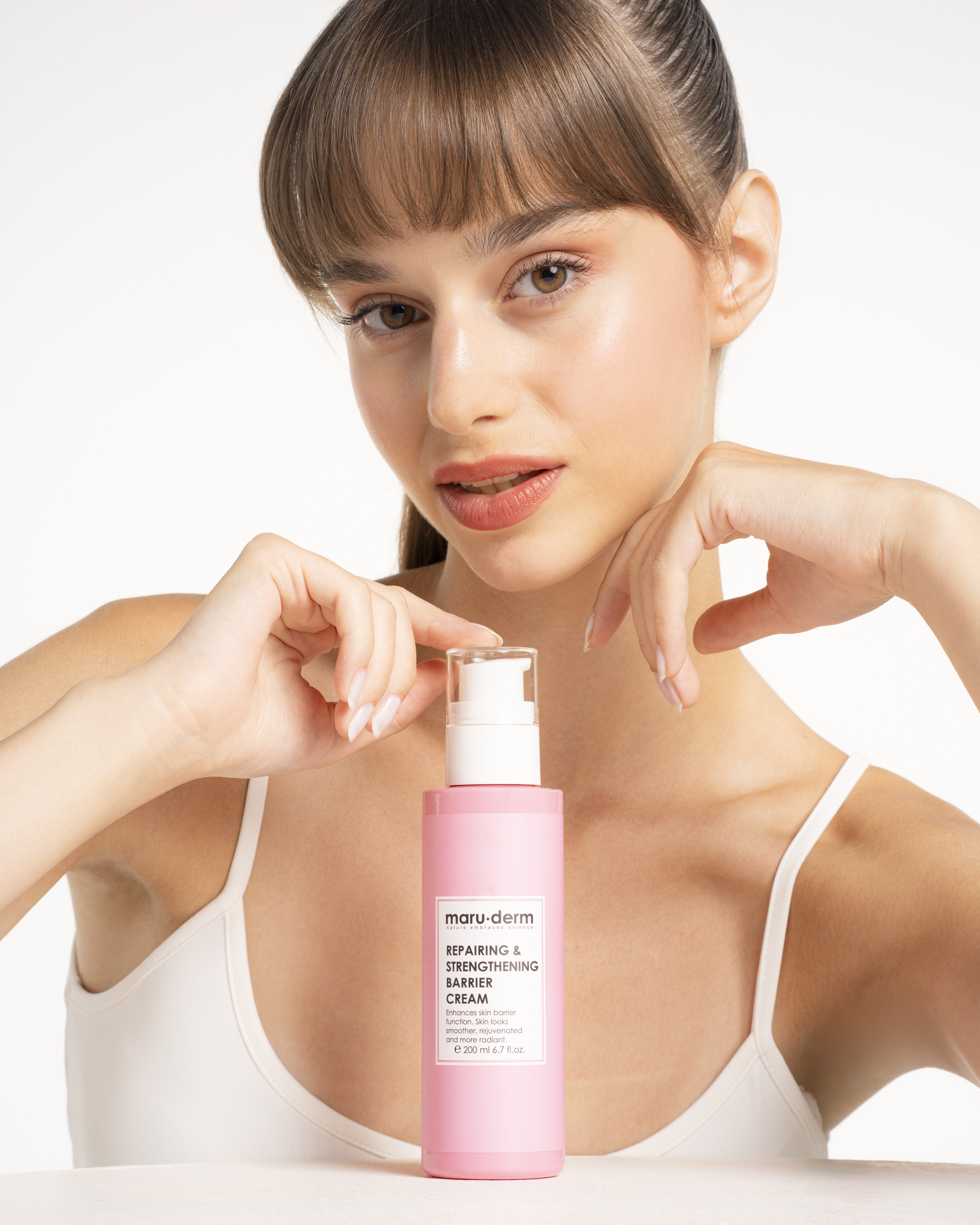
What Is Sensitive Skin?
Sensitive skin is not a single condition but a state where the skin becomes more reactive than normal. It responds strongly to triggers that would not affect balanced skin.
This can include:
Skincare products
Weather changes
Pollution
Stress
Sensitive skin is often a result of a compromised skin barrier, which reduces the skin’s ability to protect itself.
The Skin Barrier: The Key to Understanding Sensitivity
The skin barrier is the outermost layer of the skin, responsible for :
Retaining moisture
Protecting against irritants
Maintaining overall skin stability
When the barrier is healthy, the skin remains calm and resilient. When it is damaged, the skin becomes vulnerable.
A weakened barrier leads to:
Increased water loss
Higher sensitivity
More inflammation
Why Your Skin Reacts to Everything
If your skin reacts to almost every product, the problem is not the products themselves—it is the condition of your skin.
When the barrier is compromised:
Ingredients penetrate more deeply
Nerve endings become more exposed
Skin reacts more intensely
This results in:
Burning sensation
Redness
Irritation
Discomfort
Common Causes of Sensitive Skin
1. Overuse of Active Ingredients
Using too many acids, retinoids, or treatments can damage the skin barrier.
This leads to:
Irritation
Dryness
Increased sensitivity
2. Harsh Cleansing
Over-cleansing or using strong cleansers strips the skin of its natural oils.
This disrupts the balance and weakens the barrier.
Using a gentle cleanser like Maruderm Salicylic Acid Face Cleansing Gel helps maintain cleanliness without excessive stripping when used appropriately.
3. Environmental Factors
External elements such as:
Cold weather
Heat
Wind
Pollution
can weaken the skin barrier and increase sensitivity.
4. Dehydration
Lack of hydration makes the skin more vulnerable.
Dehydrated skin:
Loses elasticity
Becomes more reactive
Heals more slowly
Using Maruderm Hyaluronic Acid Moisturizing Cream helps restore hydration and support barrier function.
5. UV Exposure
Sun exposure increases inflammation and weakens the skin barrier.
Daily use of Maruderm SPF 50+ Vitamin C Sunscreen helps protect sensitive skin from further damage.
Symptoms of Sensitive Skin
Sensitive skin can present in different ways:
Redness
Burning or stinging sensation
Tightness
Dry patches
Itching
Flaking
These symptoms may appear immediately after applying products or gradually over time.
How to Identify If You Have Sensitive Skin
You may have sensitive skin if:
Products frequently cause irritation
Your skin reacts to weather changes
You experience redness or discomfort regularly
Your skin feels tight or dry even after moisturizing
The Difference Between Sensitive and Reactive Skin
Sensitive skin is a general condition, while reactive skin refers to how the skin responds to triggers.
Reactive skin:
Shows immediate reactions
Is often more unstable
Requires extra care
Why Treating Sensitive Skin Requires a Different Approach
Sensitive skin cannot tolerate aggressive treatments.
Common mistakes include:
Over-exfoliating
Using strong actives
Layering too many products
Instead, treatment should focus on:
Restoring the barrier
Reducing inflammation
Simplifying the routine
The Importance of Barrier Repair
Barrier repair is the foundation of treating sensitive skin.
A strong barrier:
Reduces reactivity
Improves hydration
Protects against irritants
Without repairing the barrier, sensitivity will continue.
Building the Foundation of a Sensitive Skin Routine
A proper routine should be:
Simple
Gentle
Consistent
Core steps include:
Cleansing
Hydration
Protection
FAQ
1. What causes sensitive skin?
A weakened skin barrier.
2. Is sensitive skin permanent?
It can improve with proper care.
3. Why does my skin react to everything?
Because the barrier is compromised.
4. Can dehydration cause sensitivity?
Yes, it increases reactivity.
5. Is sensitive skin the same as dry skin?
No, but they can overlap.
6. Can sunscreen help sensitive skin?
Yes, it protects against irritation.
7. Should I avoid all active ingredients?
Not all, but use them carefully.
8. Can weather affect sensitive skin?
Yes, significantly.
9. How do I calm irritated skin?
Simplify your routine and hydrate.
10. What is the most important step?
Barrier repair.
How to Build a Skincare Routine for Sensitive Skin
Sensitive skin requires a fundamentally different approach compared to other skin types. The goal is not to aggressively treat concerns but to stabilize the skin, reduce reactivity, and strengthen the barrier over time.
A well-structured routine should be:
Minimal
Gentle
Consistent
The fewer unnecessary steps you include, the better your skin can recover.
Step 1: Gentle Cleansing
Cleansing is essential, but it must be done carefully.
Sensitive skin reacts negatively to:
Strong surfactants
Over-cleansing
Hot water
Use a mild cleanser that removes impurities without stripping the skin.
Maruderm Salicylic Acid Face Cleansing Gel can be used carefully for sensitive, acne-prone skin when applied gently and not overused. It helps maintain pore clarity while supporting skin balance.
Key tips:
Cleanse twice daily at most
Use lukewarm water
Avoid scrubbing
Step 2: Hydration and Barrier Support
Hydration is the most important step for sensitive skin.
When the skin lacks moisture:
The barrier weakens
Irritation increases
Recovery slows down
Using Maruderm Hyaluronic Acid Moisturizing Cream helps:
Restore moisture levels
Improve elasticity
Support barrier repair
Apply moisturizer on slightly damp skin to maximize hydration.
Step 3: Daily Protection
Sensitive skin is highly vulnerable to UV damage.
Sun exposure:
Increases inflammation
Weakens the barrier
Triggers redness and irritation
Daily use of Maruderm SPF 50+ Vitamin C Sunscreen helps:
Protect against UV damage
Reduce inflammation
Prevent long-term sensitivity
Sunscreen should always be the final step in your morning routine.
Minimal Skincare Routine: Less Is More Approach
One of the most effective strategies for sensitive skin is simplifying your routine.
Using too many products can:
Overload the skin
Increase irritation
Delay recovery
A minimal routine focuses only on essential steps:
Cleanse
Moisturize
Protect
This allows the skin to reset and rebuild its natural defenses.
Ingredients to Avoid If You Have Sensitive Skin
Certain ingredients are more likely to trigger irritation.
1. High-Strength Acids
Frequent use of strong exfoliants can damage the barrier.
Avoid:
High concentrations of AHAs
Frequent BHA overuse
2. Alcohol-Based Formulas
Alcohol can strip the skin and increase dryness.
This leads to:
Tightness
Irritation
Increased sensitivity
3. Fragrance
Fragrance is one of the most common triggers of irritation.
Even small amounts can cause:
Redness
Burning sensation
Allergic reactions
4. Essential Oils (in High Concentrations)
While natural, essential oils can be irritating for sensitive skin.
5. Overlapping Active Ingredients
Using multiple actives together increases the risk of irritation.
Examples:
Retinol + strong acids
Multiple exfoliants
Why Your Skin Reacts to Everything
When the skin barrier is compromised, even mild ingredients can cause reactions.
This is because:
The protective layer is weakened
Irritants penetrate more easily
Nerve endings are more exposed
The solution is not to eliminate all products, but to restore the barrier.
How to Reset Sensitive Skin (Barrier Recovery Phase)
If your skin is highly reactive, a reset period is necessary.
Step 1: Stop All Non-Essential Products
Remove:
Strong actives
Exfoliants
New or experimental products
Step 2: Focus on Hydration
Use Maruderm Hyaluronic Acid Moisturizing Cream consistently to restore moisture.
Step 3: Protect Daily
Apply Maruderm SPF 50+ Vitamin C Sunscreen every morning.
Step 4: Maintain Simplicity
Keep your routine minimal until sensitivity decreases.
How Long Does Barrier Repair Take?
Recovery time depends on the level of damage.
Typical timeline:
1–2 weeks: Reduced irritation
3–4 weeks: Improved hydration
4–6 weeks: Stronger barrier
Consistency is key to achieving results.
How to Reintroduce Active Ingredients Safely
Once the skin stabilizes, actives can be reintroduced slowly.
Guidelines:
Introduce one ingredient at a time
Start with low frequency
Monitor skin response
Avoid returning to aggressive routines.
The Role of Lifestyle in Sensitive Skin
Stress
Stress increases inflammation and worsens sensitivity.
Sleep
Poor sleep affects skin repair and barrier function.
Environment
Pollution and climate conditions can trigger reactions.
FAQ
1. What is the best routine for sensitive skin?
A simple routine with cleansing, moisturizing, and sunscreen.
2. Should I avoid all acids?
Not completely, but use them carefully.
3. Can sensitive skin use salicylic acid?
Yes, in low frequency and gentle formulations.
4. Is moisturizer necessary?
Yes, it is essential for barrier repair.
5. How do I know if my barrier is damaged?
If your skin feels irritated, tight, or reactive.
6. Can fragrance cause irritation?
Yes, it is a common trigger.
7. How long does recovery take?
Usually a few weeks with proper care.
8. Should I use fewer products?
Yes, minimal routines work best.
9. Can sunscreen irritate sensitive skin?
Proper formulations should not.
10. What is the biggest mistake?
Using too many active ingredients.
Barrier Repair Guide for Reactive Skin
When dealing with sensitive or reactive skin, barrier repair is not just one step in a routine—it is the entire strategy. Without restoring the skin barrier, any treatment will remain temporary and irritation will continue.
Reactive skin is essentially skin that has lost its ability to defend itself. This means that even normal environmental exposure or mild skincare products can trigger discomfort.
What Happens When the Skin Barrier Is Damaged
A compromised barrier leads to:
Increased transepidermal water loss (TEWL)
Greater penetration of irritants
Higher inflammation levels
Slower healing
This creates a cycle where the skin becomes progressively more sensitive.
Signs Your Skin Barrier Is Damaged
Persistent redness
Burning or stinging sensation
Tightness after cleansing
Flaking or dryness
Sudden breakouts or irritation
If multiple symptoms are present, barrier repair should be the immediate focus.
Step-by-Step Barrier Repair Routine
Step 1: Simplify Everything
The first step is to remove anything that may be irritating the skin.
Avoid:
Strong exfoliants
Retinoids
Fragrance-heavy products
Complex routines
Focus only on essential steps.
Step 2: Gentle Cleansing
Cleansing should remove impurities without stripping natural oils.
Use Maruderm Salicylic Acid Face Cleansing Gel cautiously and avoid overuse. For highly sensitive skin, reduce frequency to prevent further irritation.
Key approach:
Cleanse once or twice daily
Avoid hot water
Do not scrub
Step 3: Intensive Hydration
Hydration is critical for restoring barrier function.
Using Maruderm Hyaluronic Acid Moisturizing Cream helps:
Retain moisture
Improve elasticity
Reduce tightness
Apply consistently to support recovery.
Step 4: Daily Protection
UV exposure slows barrier repair and increases sensitivity.
Using Maruderm SPF 50+ Vitamin C Sunscreen:
Protects against UV damage
Reduces inflammation
Supports healing
This step is essential, even when staying indoors.
How Barrier Repair Improves Skin Over Time
With consistent care:
Redness decreases
Skin becomes less reactive
Hydration improves
Tolerance to products increases
This transformation does not happen instantly, but it becomes noticeable over weeks.
Minimal Skincare Routine (Long-Term Strategy)
Once the skin stabilizes, maintaining a minimal routine is often the best approach.
A long-term routine should include:
Gentle cleansing
Consistent moisturizing
Daily sun protection
This prevents future damage and keeps the skin balanced.
Why Less Is More for Sensitive Skin
Adding more products does not mean better results.
Overloading the skin leads to:
Increased irritation
Barrier damage
Product conflicts
A simplified routine allows the skin to function naturally and maintain balance.
When to Add Treatments Back Into Your Routine
Once sensitivity decreases, additional treatments can be introduced gradually.
Guidelines:
Add one product at a time
Monitor skin reaction
Avoid combining strong actives
This helps maintain stability while improving skin concerns.
How to Prevent Sensitive Skin Long-Term
Preventing sensitivity is easier than treating it.
Key habits include:
Avoiding over-exfoliation
Maintaining hydration
Using sunscreen daily
Keeping routines simple
Being consistent
The Role of Consistency in Skin Health
Skin health depends on repeated, consistent care rather than short-term solutions.
Irregular routines:
Disrupt the barrier
Slow down recovery
Increase reactivity
Consistency allows the skin to rebuild and maintain strength.
How Sensitive Skin Affects Other Skin Concerns
Sensitive skin often overlaps with other conditions:
Acne becomes more inflammatory
Hyperpigmentation becomes more persistent
Aging signs appear more quickly
This is why treating sensitivity improves overall skin health.
Final Perspective: Treating Sensitive Skin the Right Way
Sensitive skin is not something that should be aggressively treated. It requires a controlled, patient, and supportive approach.
The most effective strategy focuses on:
Restoring the skin barrier
Reducing inflammation
Simplifying routines
Protecting the skin daily
With the right approach, sensitive skin can become stronger, more balanced, and less reactive over time.
FAQ
1. How do I repair my skin barrier?
Simplify your routine and focus on hydration and protection.
2. How long does barrier repair take?
Usually several weeks with consistent care.
3. Can sensitive skin become normal again?
Yes, with proper routine and barrier repair.
4. Should I stop all active ingredients?
Temporarily, until the skin stabilizes.
5. Can sunscreen help repair the barrier?
It protects the skin and supports recovery.
6. Is hydration the most important step?
Yes, it is essential for barrier repair.
7. Can I exfoliate sensitive skin?
Only gently and not frequently.
8. Why does my skin burn after products?
Because the barrier is compromised.
9. Can I use fewer products?
Yes, minimal routines work best.
10. What is the key to long-term results?
Consistency and simplicity.